Nanit
- 3.8
- Rating
- 500.00K
- Installs
- Free
- Price

 Analysis by App-foxy
When I use a baby-monitoring app, I want it to reduce the number of times I have to open the nursery door, not give me another screen to worry about. Nanit makes a convincing case for itself because it puts the baby-watching task inside a phone app that is easy to check during ordinary family life. My overall view is positive, but with an important condition: it works best for parents who want a connected monitoring experience and are comfortable paying for more than the free download may provide.
Nanit is a parenting app from Nanit, available at no cost to install and rated for Everyone. It has been around since late 2016, and its current Android release is version 4.54.0, with Android 10 or newer required. The app has built a noticeable user base, with more than one hundred thousand installs, an average rating of 4.0 from roughly ten thousand ratings, and about 2.9 thousand written reviews. Those figures suggest a product that many families find useful, while also hinting that the experience is not universally effortless.
What using Nanit feels like in everyday parenting
I find Nanit most useful when a quick visual check can help me decide whether to step into the nursery or let the baby settle. This section looks at how that small decision fits into everyday routines, and why a phone-based monitor can feel convenient without replacing a caregiver’s judgment.
You May Also Like

 Blood Strike: 2.5 Anniversary
Blood Strike’s Loadouts Turn Every Drop Into a Tactical Gamble
A close look at Blood Strike’s custom loadouts: how fast access to signature weapons reshapes its battle royale rhythm, rewards preparation, and narrows the gap between fights.

 Pandora - Music & Podcasts
Pandora’s Music Is Easy to Start, but Harder to Recover
Pandora’s strength is its low-effort path from a seed to a station. Its weak spot is how much confidence it asks you to place in connection, setup, and quiet recovery.

 8 Ball Pool
 Is Built on Rivalries, Rematches, and Routine
A close look at the rivalries, rematches, shared routines, and unanswered safety questions that turn a quick pool match into a persistent mobile community.

 Samsung Music
’s Quiet Strength Is Playing What You Already Own
Its reach comes less from spectacle than from dependable access to a personal library. That simplicity is both the app’s strongest retention engine and its ceiling.

 AccuWeather: Weather Radar
AccuWeather Review: A Quick, Clear Forecast for Everyday Decisions
For everyday plans, the best forecast is the one you can understand quickly. AccuWeather makes rain timing, radar, and local conditions easy to act on, with a few trade-offs.

 Hill Climb Racing
Why Hill Climb Racing Still Turns Crashes Into One More Run
A tiny car, a bumpy hill and one more upgrade: Hill Climb Racing keeps resurfacing because its simple chaos makes every near-miss feel personal.
More From Our News Desk



A calmer way to check without interrupting sleep
The clearest value is convenience. Instead of relying on a separate monitor screen that has to stay nearby, I can use a phone as the place where I check in. That matters during the small gaps of parenting: preparing a bottle, folding laundry, answering a message, or sitting in another room after finally getting the baby settled.
The difference is not simply that a phone can show video. The useful part is the habit it encourages. I can make a quick check, decide whether the baby is still sleeping, and return to what I was doing. A dedicated monitor can do something similar, but it usually means carrying one more device. Nanit fits more naturally into a routine built around a phone.
There is also a psychological benefit. Parents often wake at the slightest sound and immediately wonder whether they need to intervene. A visual check can help separate a brief movement from a genuine need. I would not treat the app as a substitute for being attentive, but it can reduce unnecessary trips to the nursery and make nighttime decisions feel less uncertain.
Where the app is especially practical
Nanit makes the most sense in homes where more than one adult needs to stay aware of the baby. One parent may be preparing dinner while another is settling the child, or a caregiver may need to check the nursery while the parent is occupied elsewhere. A phone-based approach is easier to fit around those changing responsibilities than a monitor that belongs to one person.
A realistic example is an early evening when the baby has just gone down. I might keep the phone nearby while cleaning the kitchen, glance at the app when I hear movement, and avoid opening the door unless the situation actually calls for it. Later, if I move to another room, the same app remains part of the routine instead of forcing me to remember where a separate receiver was left.
That workflow is simple, but it is also where Nanit earns its place. The app is not valuable because parents want to stare at a screen continuously. It is valuable because short, purposeful checks are easier when the monitoring tool is already available on a familiar device.
The free download and the paid boundary
The app itself is free, but Nanit includes in-app purchases ranging from $69.99 to $349.99 per item. That is the first point I would explain to a friend before recommending it. “Free” describes the app download, not necessarily the complete experience a family may want to build around it.
This pricing structure changes how I evaluate the product. A parent who only wants to explore the app or already has the compatible Nanit setup may be comfortable starting without an immediate payment. Someone comparing it with a basic audio monitor, a standard camera, or an inexpensive standalone video monitor should calculate the full cost of the preferred setup rather than stopping at the download price.
The higher purchase range also means Nanit is not automatically the sensible choice for every household. If the goal is simply hearing a baby wake up, an audio monitor may be enough. If the goal is occasional visual reassurance, a simpler camera solution may offer better value. Nanit is aimed at parents who place a higher value on an integrated monitoring experience than on the lowest possible entry cost.
Why the phone format is both a strength and a weakness
Using a phone is convenient, but it introduces a trade-off that is easy to overlook. The phone is also where calls, messages, work alerts, low-battery warnings, and other distractions arrive. A dedicated monitor is less likely to pull attention in several directions at once. With Nanit, I would be deliberate about how I use the phone during sleep checks, especially at night when a bright screen can become more disruptive than helpful.
Battery habits matter too. A parent who spends much of the day away from a charger may not want monitoring to become another reason to keep the phone plugged in. I would make charging part of the nursery routine and avoid assuming that a phone used for monitoring will always be ready for everything else. This is not a flaw unique to Nanit, but it is a meaningful consequence of choosing a phone-centered system.
What the rating tells me as a buyer
The 4.0 average is respectable rather than exceptional. I read that as a reason to approach the app with realistic expectations. It appears useful enough for a substantial group of parents, but the rating does not support treating it as a flawless, universal solution.
The written review count, at around 2.9 thousand, is more helpful than a single enthusiastic description because it indicates that families have had enough experience to identify both convenience and friction. I would still judge the app in the context of my own priorities: quick access, the cost of the broader Nanit setup, phone dependence, and whether I need more than basic observation.
Small habits that make the experience better
My first practical tip is to decide in advance what a “check” is for. If I open the app every time the baby moves, I may create anxiety rather than reduce it. A better routine is to use it for a specific question: Is the baby awake? Is the baby still settled? Do I need to go in? That keeps the app from becoming an endless source of visual reassurance.
Second, I would keep the phone in a consistent place during naps and bedtime. The advantage of Nanit disappears if I am constantly searching for the device or checking it from an awkward angle. A predictable location also makes it easier to preserve a quiet routine instead of turning every check into a full interruption.
Third, I would test the complete routine before depending on it overnight. That means checking the app during a normal nap, confirming that the phone is charged, and making sure every regular caregiver understands how the family intends to use it. The important lesson is that a monitoring app is part of a household workflow, not just an icon installed on a phone.
Making the choice with your household in mind
Before choosing a monitor, I would ask what I actually need to know during a nap. If sound alone is enough to prompt me to check, an audio-only device keeps the routine simple and avoids relying on a phone screen. If seeing the baby would help me decide whether to enter the room, a video-based option makes more sense. The important distinction is not which format sounds more advanced; it is whether visual checks will change what I do.
For families considering Nanit, a useful first step is to map out who will use it and when. If one caregiver handles bedtime while another takes over later, agree on where the phone will be and how each person will make a check. That small conversation can prevent a familiar problem: both adults assuming the other is keeping an eye on things, or both repeatedly checking because neither knows the routine.
It is also worth considering how the household behaves when the phone is needed for something else. A parent taking an important call, for example, may prefer a dedicated receiver that stays available for monitoring. A phone-centered system works best when users are comfortable keeping the device accessible and can avoid turning every notification into a reason to leave the baby view.
What to test before relying on it
I would try the setup during an ordinary daytime nap before making it part of the overnight routine. That is a low-pressure chance to see whether opening the app feels convenient, whether the phone is usually within reach, and whether looking at the screen actually answers the questions I have. If I find myself checking repeatedly without making better decisions, the phone view may not be adding much for my family.
Caregivers should also agree on the limits of the tool. A screen can offer reassurance, but it cannot replace a parent’s judgment or the need to respond in person. If a child’s condition or a specific care plan calls for closer supervision, I would follow professional guidance rather than treating a consumer monitoring app as a substitute.
That distinction matters because baby-monitoring needs change. A family may value frequent visual checks at one stage and prefer a simpler arrangement later. I would treat the purchase as a choice about today’s routine, not as a promise that the same setup will remain necessary indefinitely.
Who should choose it—and who should skip it
I would recommend Nanit to parents who want phone-based access, expect to check in regularly, and are willing to consider the paid parts of a connected baby-monitoring system. It is particularly appealing for families who dislike carrying a separate monitor and want a familiar device to be the center of their routine.
I would be more cautious about recommending it to someone shopping strictly by price. The in-app purchase range can make the overall commitment much larger than the free label suggests. I would also steer away from it for parents who prefer a simple, dedicated device with no phone distractions, or for households where audio alerts are all that is needed.
It may also be a poor fit for anyone who expects technology to remove the need for judgment. Nanit can help with observation, but it cannot decide when a baby needs comfort, feeding, medical attention, or a parent in the room. The app should support a caregiving routine, not replace it.
My final view of Nanit
After weighing the convenience against the cost and phone dependence, I see Nanit as a capable parenting companion rather than an automatic purchase. Its strongest quality is practical: it makes quick baby checks fit into the rest of the day. That is genuinely useful when parents are moving between rooms, sharing responsibilities, or trying to protect a sleeping routine.
Its main weakness is equally practical. The free app can lead users toward a broader paid commitment, and the phone-based format brings battery concerns and everyday digital distractions. Those limitations do not cancel the benefits, but they should be part of the decision from the beginning.
For the right family, Nanit can make monitoring feel less cumbersome and more connected to real life. For a parent who wants the cheapest or simplest possible option, a basic audio monitor or a less integrated alternative may be the wiser choice. My recommendation is to choose Nanit for convenience and a connected routine, not merely because the download costs nothing.
FAQs for Nanit
01What features does the Nanit app offer for baby monitoring?
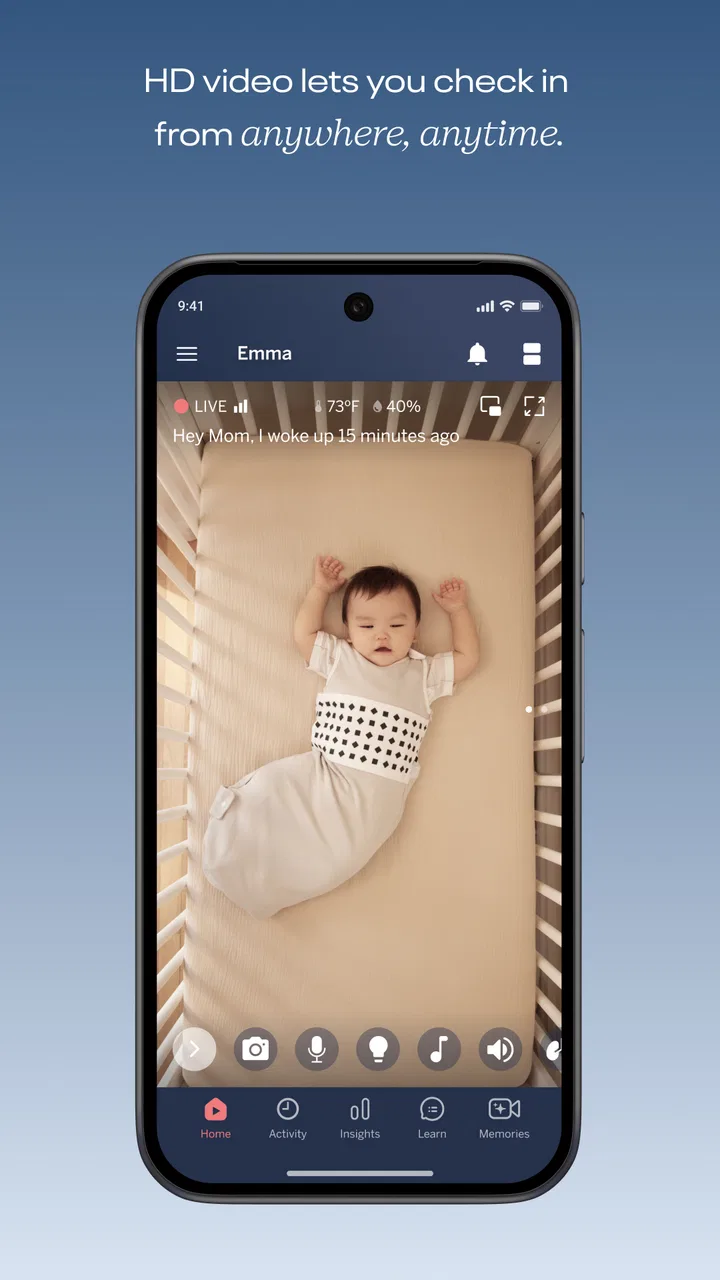
The Nanit app provides a comprehensive suite of features for baby monitoring, including sleep tracking, breathing motion monitoring, and personalized sleep guidance. It also offers two-way audio, temperature and humidity sensors, and a nightlight. Parents can review sleep trends and milestones, ensuring they have detailed insights into their baby's sleep patterns.
02Is the Nanit app compatible with all smartphones?
The Nanit app is compatible with both iOS and Android devices, ensuring a wide range of usability for most smartphone users. It's important to check that your device meets the minimum operating system requirements: iOS 12.0 or later for Apple devices, and Android 6.0 or later for Android devices, to ensure optimal performance.
03How secure is the Nanit app in terms of data privacy?
Nanit prioritizes user privacy and data security by employing end-to-end encryption for all video and audio feeds. The app requires secure login, and users can control who has access to their baby's monitoring data. Regular updates are provided to enhance security measures, ensuring that your data remains protected at all times.
04Can multiple users access the Nanit app simultaneously?
Yes, the Nanit app allows multiple users to access the monitoring system simultaneously. This feature is particularly beneficial for families, as both parents and caregivers can monitor the baby in real-time. Users can customize access permissions, ensuring that only authorized individuals can view the live feed and access stored information.
05Does the Nanit app require a subscription for full access to features?
While the Nanit app provides basic functionalities for free, a subscription is required to unlock advanced features like sleep tracking analytics, video history, and expert sleep guidance. Subscription plans are offered at various tiers, allowing users to choose the level of service that best fits their needs and budget.
Pros
- High-definition video quality.
- Real-time sleep tracking.
- Temperature and humidity sensors.
- Two-way audio communication.
- Easy setup and user-friendly interface.
Cons
- Subscription required for full features.
- Limited zoom capability.
- App occasionally crashes.
- Short battery life on mobile devices.
- Some features need strong Wi-Fi.

Nanit
Gallery